





ICPAC BANNER

|Home |


Announcements


»ICPAC bidding document of vehicle

»ICPAC bidding document for IT equipment

»TOR for Observatory Needs Expert

»TOR for Impact & Vulnerability Assessment Expert


News & Upcoming Events


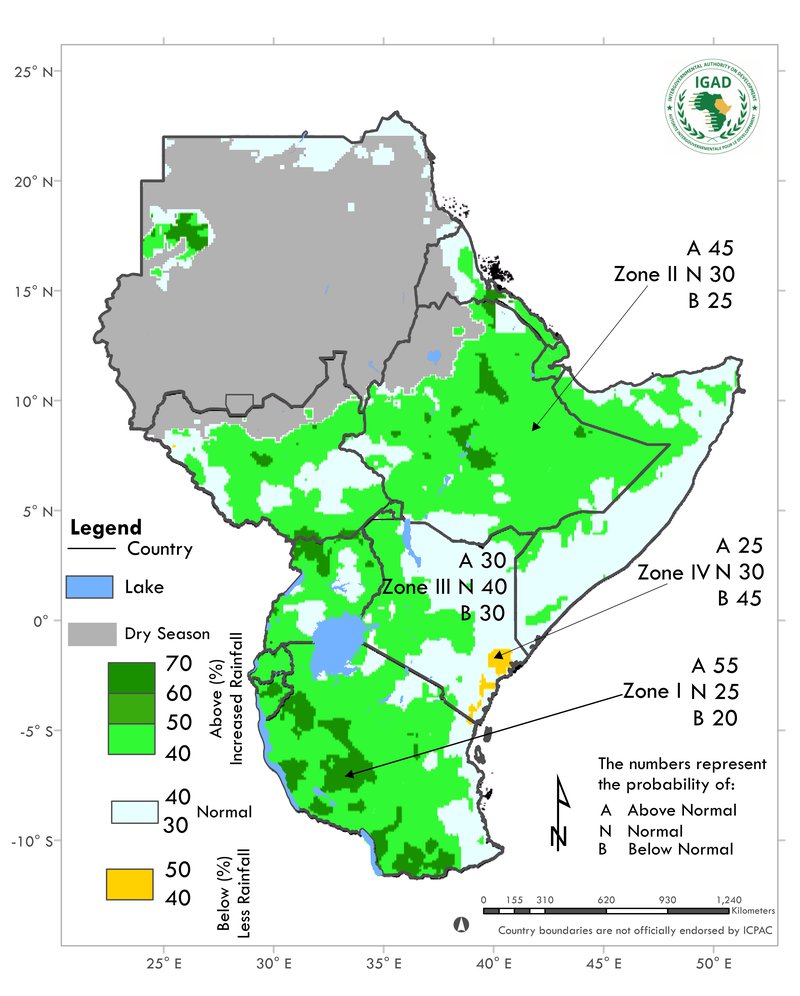
»GHACOF30 STATEMENT FOR MARCH-MAY RAINFALL SEASON

»GHACOF 30 INFORMATION NOTE

»Climate Watch For May 2011

»ICPAC Newsletter »


»Check Email


Background

The Greater Horn of Africa (GHA) is prone to extreme climate events such as droughts and floods. These extreme events have severe negative impacts on key socio-economic sectors of all the countries in the sub-region.
In 1989, twenty four countries in Eastern and Southern Africa established a Drought Monitoring Centre with its headquarters in Nairobi (the DMCN) and a sub centre in Harare (Drought Monitoring Centre Harare – DMCH) in response to the devastating weather related disasters. In October 2003, the Heads of State and Governments of the Intergovernmental Authority on Development (IGAD) held their 10th Summit in Kampala, Uganda, where DMCN was adopted as a specialized IGAD institution. The name of the institution was at the same time changed to IGAD Climate Prediction and Applications Centre (ICPAC) in order to better reflect all its mandates, mission and objectives within the IGAD system. A Protocol integrating the institution fully into IGAD was however signed on 13 April 2007.
The centre is responsible for seven member countries namely: Djibouti, Eritrea, Ethiopia, Kenya, Somalia, Sudan and Uganda as well as Burundi, Rwanda and Tanzania

Vision

To become a viable regional centre of excellence in climate prediction and applications for climate risk management, environmental management, and sustainable development.


Mission


Provision of timely climate early warning information and supporting specific sector applications to enable the region cope with various risks associated with extreme climate variability and change for poverty alleviation, environment management and sustainable development of the member countries.

Objectives

The objectives of the Centre are:

I) To provide timely climate early warning information and support specific sector applications for the mitigation of the impacts of climate variability and change for poverty alleviation, management of environment and sustainable development;

II) To improve the technical capacity of producers and users of climatic information, in order to enhance the use of climate monitoring and forecasting products in climate risk management and environment management;

III) To develop an improved, proactive, timely, broad-based system of information/product dissemination and feedback, at both sub-regional and national scales through national partners;

IV) To expand climate knowledge base and applications within the sub-region in order to facilitate informed decision making on climate risk related issues; and

V) To maintain quality controlled databases and information systems required for risk/vulnerability assessment, mapping and general support to the national/ regional climate risk reduction strategies.

Functions

The functions of the Centre include:

I) Acquisition of climate and remotely sensed data

II) Develop and archive national and regional climate databanks including calibration of remote sensing records;

III) Process data and develop basic climatological statistics required for baseline risk scenarios and other applications;

IV) Monitor, predict and provide early warning information of the space-time evolutions of weather and climate extremes over the sub-region;

V) Hazards and climate risk mapping of the extreme climate events thresholds;

VI) Networking with WMO, the National Meteorological and Hydrological institutions as well as regional and international centers for data and information exchange;

VII) Capacity building in the generation and applications of climate information and products;

VIII) Applications of climate tools for specific climate sensitive sector risk reduction, environment management , and sustainable development, including integration of indigenous knowledge;

IX) Monitor, assess, detect and attribute climate change and associated impacts, vulnerability, adaptation and mitigation options;

X) Develop relevant tools required to address the regional climate challenges through research and applications in all climate sensitive socio-economic sectors including addressing linkages with other natural and man-made disasters; and

XI) Networking and exchange of information regarding disasters in the sub-region

Products

The Centre produces the following:

• Ten day, monthly and seasonal climate/weather bulletins
• Climate watch/El Niño updates
• Annual climate summaries

Major Achievements

1. Enhanced regional capacity enhancement for both climate scientists and users , including the use of regional climate outlook forums (COFs), and associated workshops.

2. Timely production and dissemination of climate early warning information.

3. Improvement of knowledge of processes and new empirical models for seasonal forecasts

4. Enhanced networking and collaboration between ICPAC, NMHSs and advanced regional diagnostics Centres.

5. Establishment of a continuously updated data bank for development of baseline statistics and hazards maps.

6. Successful networking with users of climate information, climate scientists, as well as gender and media groups in dissemination of weather information and products.

7. Several recognitions and awards at regional and global levels, including contribution to UNFCCC, UNCCD, ISDR, IPCC among others. The centre contributed to IPCC 2007 assessment that won the 2007 Nobel Prize.

8. Enhanced collaborations with sector specific users through pilot application projects for development of new application tools agriculture and food security, livestock, Health, water resources, conflict early warning, hydropower risk management, environment management, etc

9. Improved equipment including computing and Geographical Information System (GIS); and human resource capacity in regional climate modeling; prediction and applications.

10. Improved research collaboration including PhDs, and Msc students attachments that have led to new tools and applications.

Organization Structure

Applications Dept includes
All sectors plus Environment
Management, climate change, etc


For more Information, contact: Director, IGAD Climate Prediction and Applications Centre (ICPAC).
P.O. Box 10304, 00100 Nairobi,
KENYA.
Tel.: 254 20 3514426 Fax. 254 20 3878343 ,Telex: 22208
E-mail: director@icpac.net Website: www.icpac.net

Background | Products | Forecasts | Applications | Activities | Contact Info | ©2006 ICPAC
For more information, suggestions or comments, contact:
The Director
IGAD CLIMATE PREDICTION AND APPLICATIONS CENTRE
P.O. BOX 10304, 00100-NAIROBI, KENYA
Tel 254 20 3514426 or 254 20 3878340
Fax 254 20 3878343

E-mail: director@icpac.net or logallo@icpac.net
creative suite 5 design premium mac microsoft office 2011 home & student mac design premium cs 5.5 adobe after effects cs3 professional microsoft money 2007 deluxe microsoft windows vista ultimate sp2 adobe elements 10 mac adobe cs5.5 creative suite 4 web standard adobe cs4 design premium adobe acrobat 3d microsoft office 2007 ultimate windows server 2008 incopy cs4 office 2010 home and student web standard cs4 mac microsoft office 2007 ultimate