


European Institute of Peace Delegation Visits IGAD Climate Centre to Explore Climate-Security Nexus
The 13-member delegation, including experts from different authorities of the Government of Yemen, engaged in detailed discussions on how climate data can be transformed into actionable information for conflict prevention and resilience building.
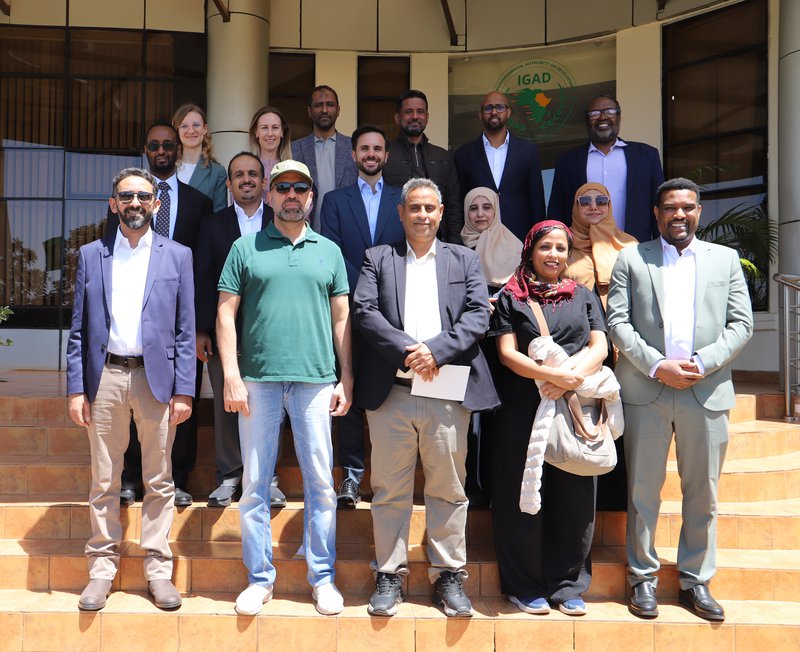
Nairobi, Kenya – December 1, 2025 – The IGAD Climate Prediction and Applications Centre (ICPAC) today hosted a high-level study visit from the European Institute of Peace (EIP), focusing on the critical link between climate change, water, early warning systems, and peace and security.
The 13-member delegation, including experts from different authorities of the Government of Yemen, engaged in detailed discussions on how climate data can be transformed into actionable information for conflict prevention and resilience building.
The visit kicked off with remarks from Dr. Hussen Seid, the Acting Head of the Climate Diagnostic and Prediction Unit, who welcomed delegates emphasizing the region’s vulnerability to climate change.
Mr. Abdikarim Mohamed, ICPAC's Climate Security Officer, briefed the delegates on the IGAD Climate Security Coordination Mechanism, a framework designed to help IGAD Member States get ahead of climate-driven conflicts before they escalate. The initiative is hosted at ICPAC and backed by the Conflict Early Warning and Response Mechanism (CEWARN).
He also underscored the research illustrating the strong correlation between rainfall patterns, vegetation cover, and conflict incidents in cross-border hotspot areas.
Dr. Modathir Zaroug, a hydrologist with ICPAC, delivered a presentation on the center's forecasting tools, which monitor hazards ranging from floods and droughts to pest outbreaks. While highlighting the center's capabilities, Dr Zaroug also acknowledged the challenges, including gaps in data availability and the urgent need for more localized forecasts.
The visit concluded with a live demonstration of ICPAC's Multi-Hazard Early Warning Situation Room. The demo showed how real-time and forecast data from ICPAC's platforms, like the East Africa Hazards Watch and the Flood Proof EA system, are integrated and visualized to support decision-making in water resources, agriculture, and disaster risk management.
The tour also included a visit to the center’s technical facilities, including its supercomputer cluster and satellite ground station, showcasing the technology powering regional climate predictions.
“This visit was a profound opportunity to see how cutting-edge climate science is directly applied to peace and security challenges,” said Ms. Laura Geres, Climate and Environmental Peacemaking Program Officer at EIP.
“Understanding the processes behind ICPAC’s work with a view to data cooperation, provides invaluable insights for our efforts in environmental peacemaking and technical dialogue,” She added.