


Our work
Increasing temperatures, higher rainfall variability, and shorter seasons (late onsets and early withdrawal of the rains) are already affecting millions of people across Eastern Africa. At ICPAC, we work to improve our understanding of climate trends, build scenarios, and analyse impacts. The high reliance of the majority of our region’s population on climate dependent resources, such as small scale farming, fishing or pastoralism, makes it one of the most vulnerable of the world to a changing climate.


Trends and projections
Analyse trends and projections of rainfall, temperature and extreme weather

Analyse Climate Extremes
Understand drivers of climate and weather extremes (ENSO, IOD, AMO)

Impacts Assessments
Understand impacts of Climate Change on livelihoods.

Scenario analysis
We analyse different climate scenarios.

Advocacy for Climate Action
We advocate for Climate Change mitigation and adaptation.

Access to Climate Finance
Increase access of member countries to Climate Finance









Latest Updates

Call for side events at the IGAD pavilion at COP 31
The Intergovernmental Authority on Development (IGAD) invites member states and partners to apply t…
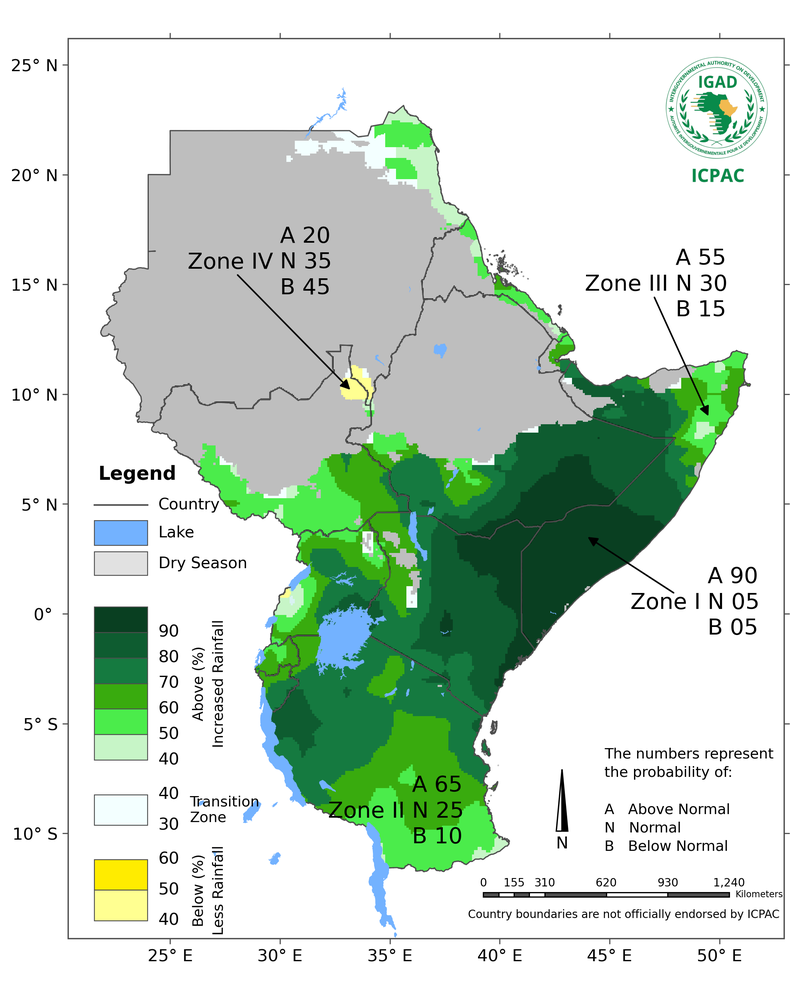
The Greater Horn of Africa is expected to experience a wetter-than-normal October – December (OND) 2026 season as El Niño strengthens
Kigali, Rwanda, 18 August 2026: The IGAD Climate Prediction and Applications Centre (ICPAC), togeth…

DESERT LOCUST RISK UNDER A STRENGTHENING EL NIÑO: IMPLICATIONS FOR THE GREATER HORN OF AFRICA
Since 2022, the Greater Horn of Africa transitioned from a regional Desert Locust upsurge to locali…

Q2 2026 Anticipatory Action Newsletter
The Q2 2026 Anticipatory Action Newsletter, produced by ICPAC, captures a quarter in which Anticipa…