


From Forecast to Action: How ICPAC Helped Uganda Take a Historic Step Toward a Safer Future
By Kennedy Wekesa, Dr Jully Ouma, Dr George Otieno, Dr Ahmed Amdihun and Victor Igbokwe
In the first week of July 2026, in a conference room in Entebbe, Uganda began writing a different kind of story, one where the warning comes first, and the action follows before the crisis peaks.
That morning on 3 July, the Government of Uganda, through the Office of the Prime Minister, officially launched two initiatives set to reshape how the country prepares for disaster: the Uganda National Multi-Hazard Integrated Early Warning System (U-MHIEWS) and the National Anticipatory Action Roadmap (2026–2031).
Behind both, quietly but unmistakably, stood the technical hand of the IGAD Climate Prediction and Applications Centre (ICPAC), working in close partnership with the European Union, Germany Federal Foreign office (GFFO) the World Food Programme (WFP), the UN Office for Disaster Risk Reduction (UNDRR), the Food and Agriculture Organization (FAO), the World Bank, and the Danish Refugee Council (DRC) among others.
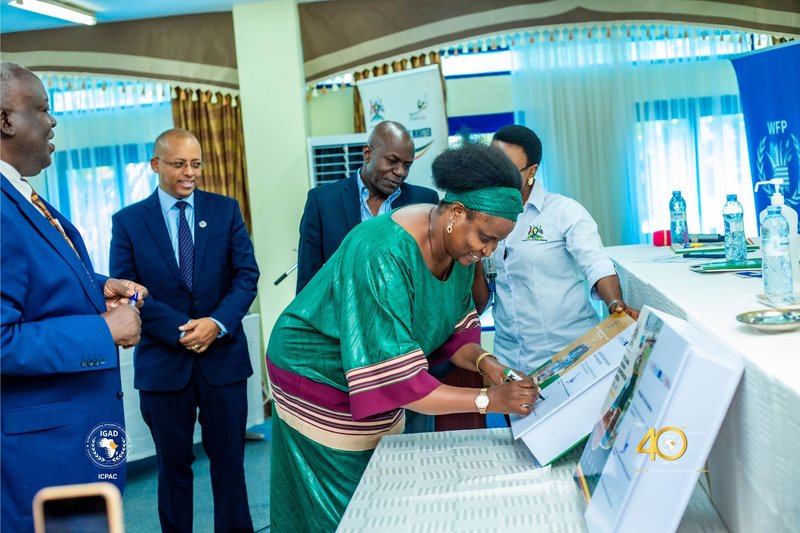
Joselyn Bigirwa, IGAD Head of Mission to the Republic of Uganda signs the commemorative launch book, marking the launch of the Uganda MHIEWS and Anticipatory Action Roadmap in Entebbe.
A System Built on Years of Groundwork
To understand why that launch mattered, it helps to look back further than the week of training that preceded it. ICPAC's role in anticipatory action across the Greater Horn of Africa did not begin with Uganda, and it will not end there. Since 2018, the Centre has been steadily building the technical and institutional scaffolding for early action across the region through pilot forecasting initiatives, regional platforms for hazard triggers and thresholds, and sustained engagement with IGAD Member States on how to turn early warning into early action, not just early information.
Uganda's launch is the latest and one of the most complete expressions of that work. The U-MHIEWS is not simply a piece of software; it is a centralized, real-time platform that draws together multi-hazard and multi-sectoral monitoring into what officials described as a "one-stop-shop" for early warning covering floods, droughts, landslide, and other hazards under a single national system. The Anticipatory Action Roadmap, meanwhile, gives that information somewhere to go: a five-year framework for coordination, financing, governance and capacity that ensures a warning is never left to stand alone.
ICPAC provided the technical architecture behind both designing the system, training the administrators who will run it, and shaping the roadmap's implementation framework alongside Ugandan counterparts across the government.
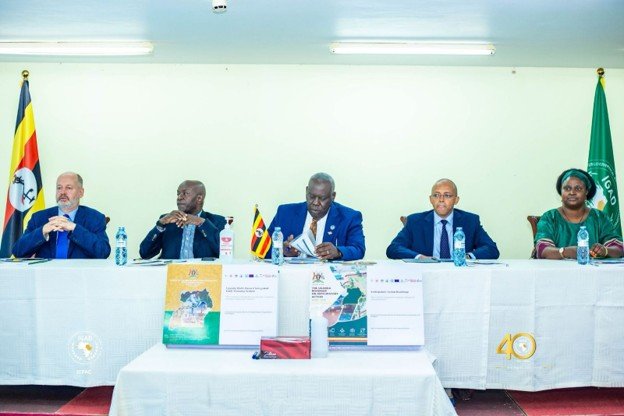
Officials at the head table during the launch of the Uganda MHIEWS and the Anticipatory Action Roadmap in Entebbe.
Leadership That Speaks for Itself
The scale of that leadership was not lost on the dignitaries who spoke at the launch. Hon. Sam Engola, Minister for Relief, Disaster Preparedness and Refugees, called on stakeholders to renew their "commitment to working together, investing in prevention, translating early warnings into timely action, and empowering local governments and communities" a commitment made possible in no small part by the technical foundation ICPAC had already laid.
Joselyn Bigirwa, IGAD Head of Mission to the Republic of Uganda, put the significance of the moment in sharper terms still: "The challenge before us is not simply managing disasters, it is managing risks," she told the audience; "and that requires a fundamental shift from reacting to disasters after they occur, to anticipating them before they happen. Today, Uganda is demonstrating regional leadership by investing not only in better information, but in better decision-support systems."
It is a quiet but significant form of influence, not the kind that makes headlines on its own, but the kind that shapes how eight IGAD Member States, as well as other ICPAC-covered countries, plan, budget, and act in the face of climate-driven risk. ICPAC's technical guidance now runs through national roadmaps, regional trigger-and-threshold systems, and country-level platforms alike, all aligned to global commitments including the Sendai Framework for Disaster Risk Reduction and the Early Warnings for All initiative. That is what regional technical leadership looks like in practice: less a seat at the table, more the architecture the table is built on.
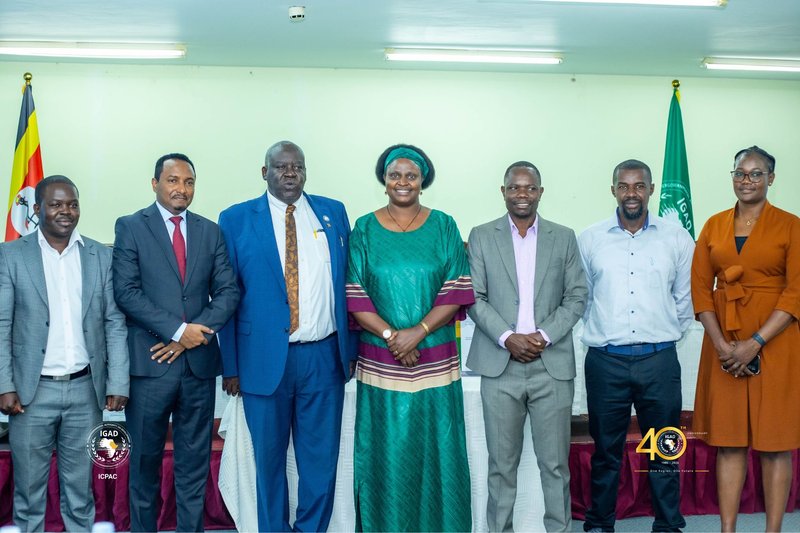
Cabinet Minister, Sam Engola (3rd from left), IGAD Head of Mission, Joselyn Bigirwa (centre) flanked by part of the ICPAC staff.
What Comes Next
For the herders of Karamoja, the farmers along Uganda's flood-prone river basins, and the families who have already lived through anticipatory interventions that arrived before disaster struck, the launch was not the end of a project, it was the start of a system built to serve them for years to come. The real test, as Bigirwa reminded the room, will not be the launch itself but what happens after: whether early warnings consistently translate into early action, and whether the investment made today protects the development gains of tomorrow.
That follow-through is already taking shape. Beyond the systems launched in Entebbe, ICPAC is supporting the Government of Uganda in setting up a national situation room in the capital, Kampala — a dedicated space where hazard data, early warning signals and response coordination will come together in real time, turning the promise of U-MHIEWS and the Roadmap into day-to-day decision-making. It is the kind of unglamorous, structural work that rarely makes headlines, but it is exactly the follow-through that turns a launch into a lasting system.
Uganda has taken that first step. ICPAC, as it has done across the region for years, provided the technical foundation to make it possible and will remain at the table long after the cameras have gone.