


Strengthening End-to-End Dissemination and Uptake of Climate Information through HUSIKA
By Paula Machio, Crimson Sikolia, Keith Korir, and Jully Ouma, in collaboration with the ICPAC Climate Change Technical Working Group

Producing an accurate forecast is only the beginning of an effective early warning system. Its value is realised when the information reaches the people who need it in a timely manner and in a format they can understand and use to make decisions.
Across the Greater Horn of Africa, significant progress has been made in climate forecasting and early warning. Yet gaps remain between the production of climate information and its use. Technical language can be difficult to interpret; information may not reach people through accessible channels or appropriate languages, and even when a warning is received, its implications and the action required may not always be clear.
It is this gap that HUSIKA, ICPAC’s multi-device climate information and early warning platform, seeks to help address. The platform connects institutions producing authoritative climate and early warning information with intermediaries such as the media and, ultimately, the communities and other users who need that information. It provides access to tailored climate information, including localised weather forecasts, seasonal outlooks, advisories, early warning alerts, and climate risk information.
Importantly, HUSIKA does not produce forecasts or independently issue warnings. At the national level, forecasts remain the mandate of National Meteorological and Hydrological Services, while warnings are issued by the relevant mandated agencies depending on the country.
HUSIKA provides the infrastructure to make this authoritative information easier to access, package, and disseminate. At the regional level, ICPAC supports the dissemination of regional climate information and works with Member States to strengthen climate services and early warning.
During the training in South Sudan in collaboration with the World Food Programme (WFP), access to HUSIKA was granted to the South Sudan Meteorological Service (SSMS), strengthening the ability and confidence to use the platform within the national climate information chain. Journalists were introduced to the platform as important intermediaries between the producers and users of this information. The same will be done for journalists in Sudan in October 2026 in collaboration with the Sudan Meteorological Authority (SMA), Save the Children Sudan (SCI), and the Sudan Ministry of Environment. Regions that have also benefited from HUSIKA are the cross-border areas of Karamoja (IGAD Cluster 1), with the inclusion of the local media in collaboration with GIZ who also supported the upgrade of the application.
HUSIKA also recognises that people access information differently. Beyond the application itself, it supports dissemination through SMS, in-app notifications and social media, while options such as audio and translation into appropriate local languages can help address barriers related to literacy, language, and accessibility. In this way, the platform is designed to make climate information more accessible to different users.
The media as part of the information chain
Technology alone cannot close the communication gap. For many communities, climate information will first be encountered through radio, television, online news stories, or social media. The media therefore plays a critical role in translating technical information into messages that people can understand, while preserving the accuracy of science. But how can the media translate what they do not understand?
Recognising this role, ICPAC is complementing the rollout of HUSIKA with capacity building for journalists across IGAD Member States. South Sudan is the first Member State to participate in this series of HUSIKA trainings for journalists, with the training in Juba conducted in collaboration with the WFP, the South Sudan Ministry of Humanitarian Affairs and Disaster Management (MoHADM), and SSMS.
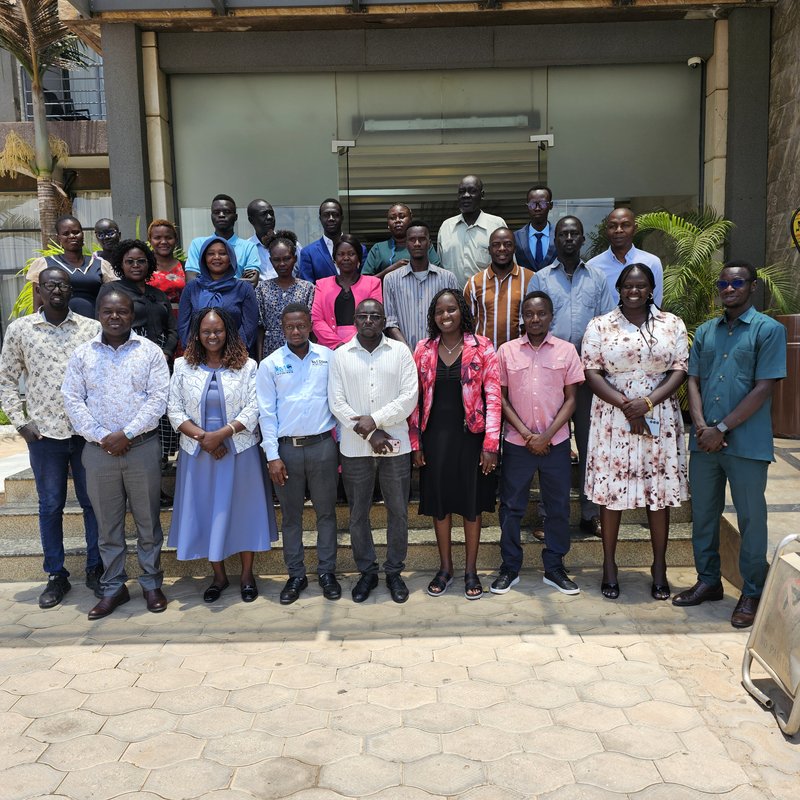
The training went beyond learning how to use the application. Journalists examined some of the challenges they face in reporting weather and climate information, including understanding, accessing authoritative sources, interpreting technical terminology and probabilities, and translating scientific information into clear public messages. These discussions explored where communication can break down along the chain from forecast to warning, media, community, understanding and action.
Participants also strengthened their understanding of the difference between a forecast and a warning, and how to communicate probabilities, potential impacts and actions without changing the science. An 80% probability of above-normal rainfall, for instance, should not become a media report stating that flooding will definitely occur. Journalists can simplify and contextualise the information but should distinguish between what is certain and what may happen, without introducing unsupported impacts or advice.
Putting HUSIKA into practice
Using the South Sudan October–December (OND) 2026 forecast issued by the SSMS, journalists worked with climate information as they would in a newsroom, translating it into radio bulletins, television stories, social media messages and print content. The exercise demonstrated a key principle: the format may change for different audiences and different channels, but the science does not.
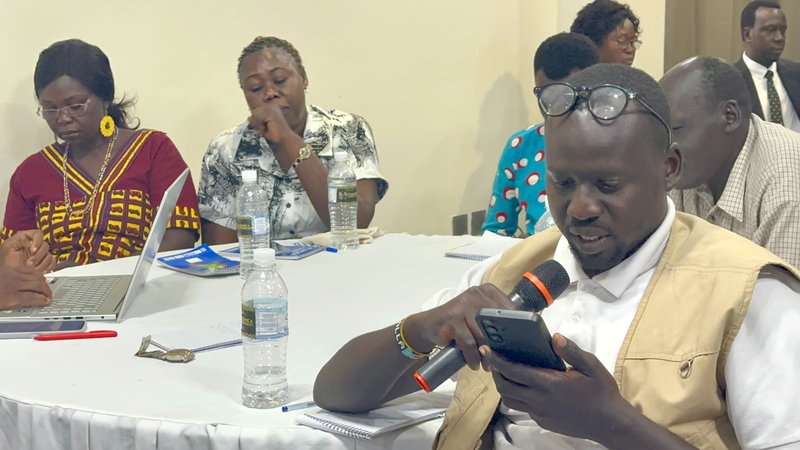
The training culminated in a simulation following information through the entire chain:
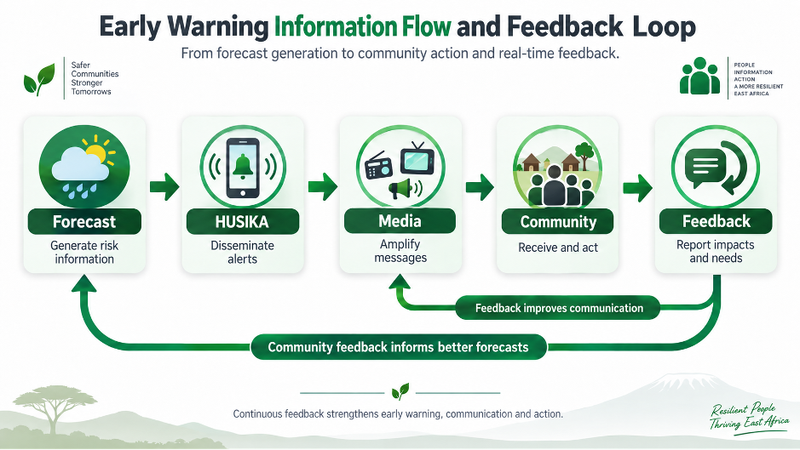
The focus was not simply on whether the message had been sent, but on what the community had actually understood. Was the information clear? Did people understand the risk? Did they know what action to take? And could their feedback travel back through the system?
This feedback loop is important because communities are not simply the end point of early warning. Information about whether a message was unclear, arrived too late or was not accessible in the appropriate language or format can help institutions and the media improve subsequent communication. Early warning therefore becomes a two-way exchange rather than a one-way broadcast.
Strengthening climate services across the region
For ICPAC, HUSIKA is part of a wider effort to strengthen the uptake of climate services and move early warning information closer to the people whose decisions and livelihoods depend on it. As a regional climate centre, ICPAC supports Member States with climate services, early warning information and decision-support tools, while strengthening national capacity to anticipate and prepare for climate-related risks.
Starting with South Sudan and expanding the HUSIKA journalist training to other IGAD Member States, the training series will help strengthen the connections between climate information producers, national institutions, the media and communities. This will be done in close collaboration with our partners on HUSIKA, i.e. GIZ, SCI, WFP, UNDP, GFFO, BUNIFU technology, and other partners are invited to join the vibrant team.
Ultimately, producing good climate information is not enough. It must be accessible, understandable and reach the right people early enough to support action. HUSIKA is the answer to this gap. #AnticipateCommuicateAtc.