


Our work
Increasing temperatures, higher rainfall variability, and shorter seasons (late onsets and early withdrawal of the rains) are already affecting millions of people across Eastern Africa. At ICPAC, we work to improve our understanding of climate trends, build scenarios, and analyse impacts. The high reliance of the majority of our region’s population on climate dependent resources, such as small scale farming, fishing or pastoralism, makes it one of the most vulnerable of the world to a changing climate.


Trends and projections
Analyse trends and projections of rainfall, temperature and extreme weather

Analyse Climate Extremes
Understand drivers of climate and weather extremes (ENSO, IOD, AMO)

Impacts Assessments
Understand impacts of Climate Change on livelihoods.

Scenario analysis
We analyse different climate scenarios.

Advocacy for Climate Action
We advocate for Climate Change mitigation and adaptation.

Access to Climate Finance
Increase access of member countries to Climate Finance









Latest Updates
Drier than usual conditions with warmer than average Temperatures expected in the Greater Horn of Africa
© Canva
Addis Ababa, Ethiopia, 19 May 2026: The IGAD Climate Prediction and Applications Centre (ICP…
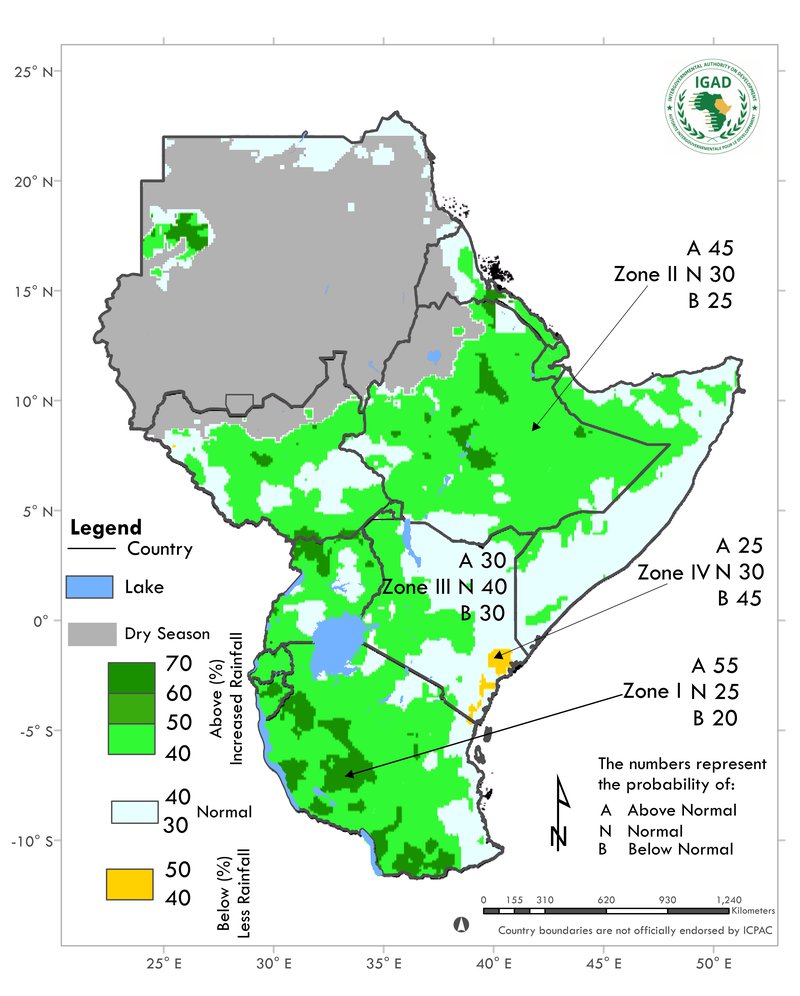
Wetter-Than-Normal Conditions Expected Across Much of the Greater Horn of Africa
Nairobi, Kenya, 27 January 2026: The IGAD Climate Prediction and Applications Centre (ICPAC) in col…

Summary for Decision Makers - June to September 2026 Season
The June to September (JJAS) 2026 rainfall outlook indicates a high likelihood of below-normal rain…

Technical Statement from the 73rd Greater Horn of Africa Climate Outlook Forum (GHACOF 73)
The June to September (JJAS) 2026 rainfall outlook indicates a high likelihood of below-normal rain…