


As a Super El Niño Builds, ICPAC Launches Its First Climate and Health Early Warning Initiative for Extreme Heat
By Dr Linda Ogallo in collaboration with the ICPAC Climate Change Technical Working Group
In February 2025, dozens of schoolchildren collapsed from heat exhaustion in Juba, forcing South Sudan’s government to shut down schools nationwide for two weeks. The message was unmistakable: extreme heat is no longer a distant threat to the Greater Horn of Africa. It is here; it is dangerous, yet the region does not yet have a system designed to warn people before it strikes.
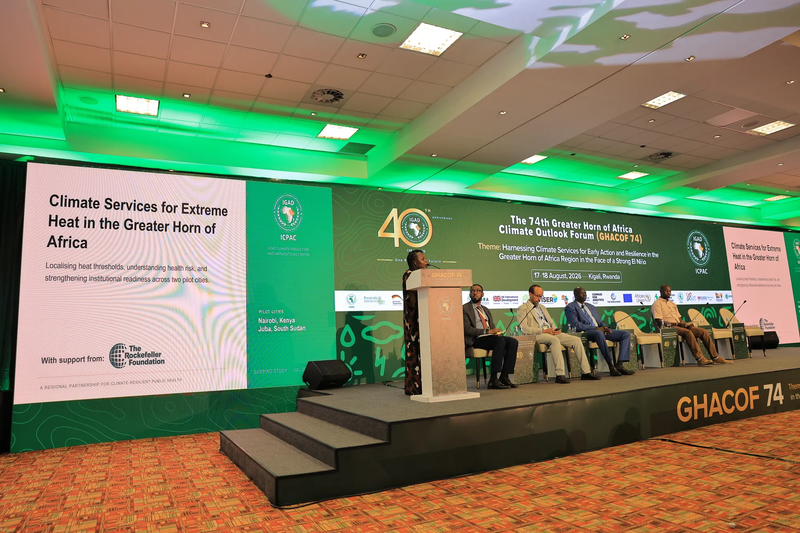
That is about to change. At the 74th Greater Horn of Africa Climate Outlook Forum (GHACOF74), held in Kigali on 17–18 August 2026, the IGAD Climate Prediction and Applications Centre (ICPAC) announced the launch of a new scoping study, Climate Services for Extreme Heat in the Greater Horn of Africa, supported by The Rockefeller Foundation. The twelve-month study will pilot the region’s first dedicated climate and health early warning system for extreme heat, beginning in two contrasting cities: Nairobi, Kenya, and Juba, South Sudan.
A launch timed to a warming world
The announcement could hardly be more timely. The seasonal outlook released at GHACOF 74 indicates an increased likelihood of warmer-than-average temperatures across the entire Greater Horn of Africa for October to December 2026. The strongest signal (up to an 85% probability) over the eastern parts of the region, including eastern Kenya, Ethiopia, Eritrea, Djibouti, and much of Somalia.
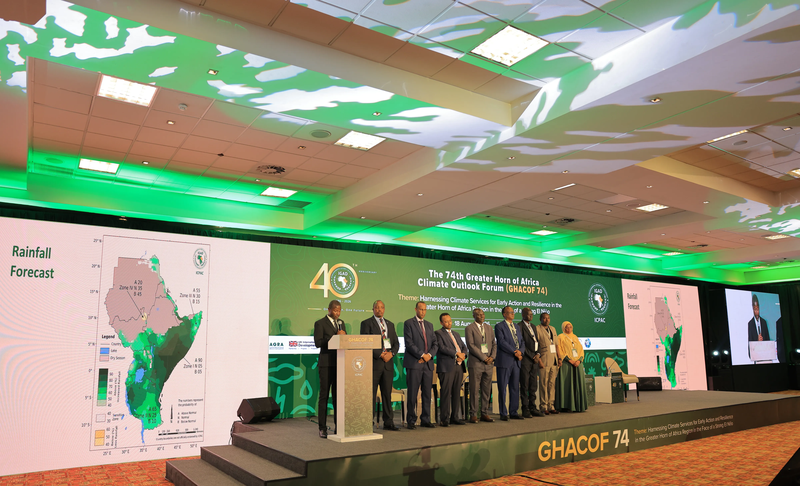
Rwandan Permanent Representative (PR) to the World Meteorological Organisation (WMO), alongside other PRs representing ICPAC Member States, release the October to December 2026 Seasonal Forecast
Driving this outlook is an El Niño event that scientists warn could be among the strongest ever observed. El Niño conditions are already established in the Pacific, and forecasts assessed at GHACOF74 indicate an 81% probability of a very strong “super” El Niño during the October to December season, with a 97% chance that conditions will persist into early 2027. A positive Indian Ocean Dipole is also expected to develop: a combination historically associated with both heavy rainfall and elevated temperatures across the region.
The regional picture sits within an extraordinary global one. According to the World Meteorological Organisation, July 2026 tied with July 2024 as one of the warmest Julys in modern history, with global temperatures reaching 1.47°C above pre-industrial levels and the highest ocean surface temperatures ever recorded for the month. Africa experienced its warmest July on record. Climate agencies now say there is a strong chance that 2026 will end as the second-warmest year ever recorded, and with a record-strength El Niño still building, some scientists believe it could go higher.
Around the world, 2026 has already shown what compounding heat looks like: successive heatwaves across Europe, record-breaking temperatures in Asia, drought, wildfires and heat-related deaths among outdoor workers. For the Greater Horn of Africa, which is warming faster than the global average, these global signals are a preview, not someone else’s problem.
Why the region needs its own heat warning system
ICPAC already monitors heat stress across the region. But the thresholds it currently uses to define “dangerous” heat were developed for occupational settings in Europe and North America, calibrated to temperate populations, not to the physiological, behavioural, and socioeconomic realities of communities in the Horn of Africa. Night-time heat, a growing killer in the region’s cities and informal settlements, is barely captured at all.
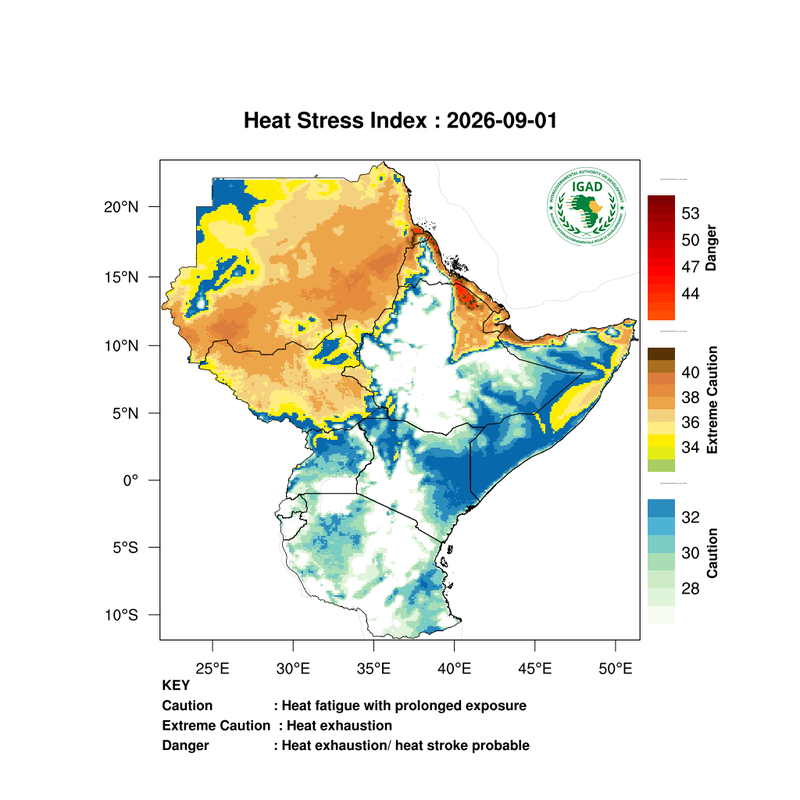
The result is a system that can misclassify risk for the very people it is meant to protect: outdoor workers, schoolchildren, pregnant women, older persons, residents of informal settlements and displaced persons.
The new study tackles this gap head-on. Working with the Kenya Meteorological Service Authority, South Sudan Meteorological Service, ministries of health and education, Nairobi City County and communities themselves, the project will develop the first locally validated heat thresholds for the region, tiered Watch, Warning and Emergency alert levels grounded in local health data and co-produced with the people most exposed.
Alongside the thresholds, the study will prototype a Heat Hazard Watch dashboard that layers heat forecasts over maps of schools, displacement camps and informal settlements, so that decision-makers can see not just where it will be hot, but who is at risk. In South Sudan, the team will work with the Ministry of Humanitarian Affairs and Disaster Management and Ministry of Education on a school heat action protocol that is integrated into the country’s existing Anticipatory Action Roadmap: defining, in advance, exactly what happens when dangerous heat is forecast: mandatory water breaks, shaded cooling zones, and clear closure procedures; so that the next heatwave does not catch the country’s classrooms unprepared. In Nairobi, heat impact assessments in Mathare, Mukuru and Kibera will feed directly into the county’s Heat Action Plan.
From forecasts to protection
The choice to launch at GHACOF is deliberate. For more than two decades, the forum has been the region’s most trusted platform for translating climate science into action across eleven member states. Heat advisories developed under the study will be embedded into GHACOF’s bulletins through its Climate and Health Working Group, the fastest route for validated heat warnings to reach every national meteorological service and health ministry in the region.
“The science of forecasting heat has advanced enormously. What has been missing is the bridge between a forecast and a protective action, a threshold that reflects how heat actually affects a child in a Juba classroom or a trader in a Nairobi market, and an agreed plan for what to do when that threshold is crossed. That is what this study will build.” ~ Dr Abdi Fidar, Director, ICPAC.
The study runs from August 2026 and is designed as a catalytic first phase: its validated thresholds will be built into ICPAC’s operational forecasts, its dashboard hosted on ICPAC’s infrastructure, and its school protocol owned by the Government of South Sudan, with a full program design ready for regional scale-up.
As the region heads into what may be one of the hottest periods in its recorded history, the ambition is simple and urgent: that no community in the Greater Horn of Africa should again learn about a deadly heatwave only when its children start to collapse.
Sources and Further Reading
Regional climate outlook and forum
IGAD Climate Prediction and Applications Centre (ICPAC). (2026). Technical Statement from the 74th Greater Horn of Africa Climate Outlook Forum (GHACOF74), 17–18 August 2026, Kigali, Rwanda. ICPAC, Nairobi. Source of the OND 2026 rainfall and temperature outlooks, El Niño and IOD assessment, and analogue-year analysis cited in this article.
IGAD Climate Prediction and Applications Centre (ICPAC). (2026). Scoping Study: Climate Services for Extreme Heat in the Greater Horn of Africa: Localising Heat Thresholds, Understanding Health Risk, and Strengthening Institutional Readiness. Project concept note submitted to The Rockefeller Foundation. ICPAC, Kajiado, Kenya.
Global temperature context
World Meteorological Organisation. (2026, 11 August). Record-breaking heat and extreme weather continue. WMO, Geneva. https://wmo.int/media/news/record-breaking-july-has-much-extreme-weather
Copernicus Climate Change Service (C3S). (2026). Monthly Climate Bulletin: July 2026. European Centre for Medium-Range Weather Forecasts, Reading. https://climate.copernicus.eu
National Oceanic and Atmospheric Administration, National Centres for Environmental Information (NOAA NCEI). (2026). Monthly Global Climate Report for July 2026. NOAA, Asheville, NC. https://www.ncei.noaa.gov/access/monitoring/monthly-report/global
The February 2025 South Sudan heatwave
World Weather Attribution. (2025, 7 March). Women and girls continue to bear disproportionate impacts of heatwaves in South Sudan that have become a constant threat. WWA rapid attribution study. https://www.worldweatherattribution.org/women-and-girls-continue-to-bear-disproportionate-impacts-of-heatwaves-in-south-sudan-that-have-become-a-constant-threat/
Heat thresholds, physiology and health risk
Brimicombe, C., Gao, C., & Otto, I. M. (2024). Vulnerable to heat stress: gaps in international standard metric thresholds. International Journal of Biometeorology, 68, 2495–2506. https://doi.org/10.1007/s00484-024-02783-6
Tochihara, Y., Wakabayashi, H., Lee, Y., Wijayanto, T., Hashiguchi, N., & Saat, M. (2022). How humans adapt to hot climates learned from the recent research on tropical indigenes. Journal of Physiological Anthropology, 41, 27. https://doi.org/10.1186/s40101-022-00302-3
Kimutai, J., Nying’uro, P., Harrington, L., Oghera, W., & Otto, F. (2022). Identification of local heat thresholds and related health impacts: The case of Nairobi, Mombasa and Kisumu Cities in Kenya. Global Heat Health Information Network. https://preparecenter.org/resource/identification-of-local-heat-thresholds-and-related-health-impacts-nairobi-mombasa-kisumu-cities-in-kenya/
International Organisation for Standardisation. (2004). ISO 7933: Ergonomics of the Thermal Environment, Analytical Determination and Interpretation of Heat Stress Using Calculation of the Predicted Heat Strain. ISO, Geneva.
American Conference of Governmental Industrial Hygienists. (2023). TLVs and BEIs: Threshold Limit Values for Chemical Substances and Physical Agents and Biological Exposure Indices. ACGIH, Cincinnati, OH.
World Resources Institute (WRI) Africa & Africa Research and Impact Network (ARIN). (2024). Urban Heat Sensing in Nairobi Informal Settlements: Participatory Monitoring and Stakeholder Engagement Report. WRI, Nairobi. https://isk.or.ke/wp-content/uploads/2026/05/Remote-Sensing-Urban-Heat-Islands-and-the-Constructed-Environment-Consequences-for-Urban-Planning-and-Surveying-in-Africa.pdf
Policy frameworks
IGAD. (2022). IGAD Climate Change Strategy and Action Plan 2023–2030. IGAD Secretariat, Djibouti. https://www.icpac.net/publications/igad-regional-climate-change-strategy-and-action-plan-2023-2030/
ICPAC. Regional Framework for Climate Services (RFCS) for the Greater Horn of Africa. ICPAC, Nairobi. https://www.icpac.net/publications/regional-framework-for-climate-services-rfcs-for-great-horn-of-africa/
Republic of South Sudan, Ministry of Health. National Action Plan for Health Security (NAPHS) 2025–2030. Juba. https://extranet.who.int/sph/file/11847/download?token=L2d3qr8v
Republic of South Sudan, Roadmap on Anticipatory Action 2025–2030 https://www.icpac.net/publications/the-south-sudan-roadmap-on-anticipatory-action-2025-2030/
The Greater Horn of Africa Climate Outlook Forum (GHACOF) is convened by ICPAC with the National Meteorological and Hydrological Services of the region, WMO and international partners. The extreme heat scoping study is supported by The Rockefeller Foundation.