


The Greater Horn of Africa is expected to experience a wetter-than-normal October – December (OND) 2026 season as El Niño strengthens
Kigali, Rwanda, 18 August 2026: The IGAD Climate Prediction and Applications Centre (ICPAC), together with the National Meteorological and Hydrological Services (NMHSs) of the Greater Horn of Africa and partners, has released the regional climate outlook for the October–December (OND) 2026 season, indicating an increased likelihood of wetter-than-normal conditions over the region.
The OND season is a critical rainfall period for the equatorial and southern parts of the Greater Horn of Africa, contributing up to 70% of total annual rainfall in parts of Ethiopia, Kenya and Somalia and up to 40% of total annual rainfall in parts of Rwanda, Burundi, Tanzania and Uganda.
The current Sea Surface Temperatures over the Pacific Ocean indicate that El Niño has developed, and it is expected to strengthen further during the remainder of the year (2026). Furthermore, the Indian Ocean Dipole (IOD) is also expected to be in the positive phase. These conditions normally lead to enhanced rainfall over the region during the OND season.
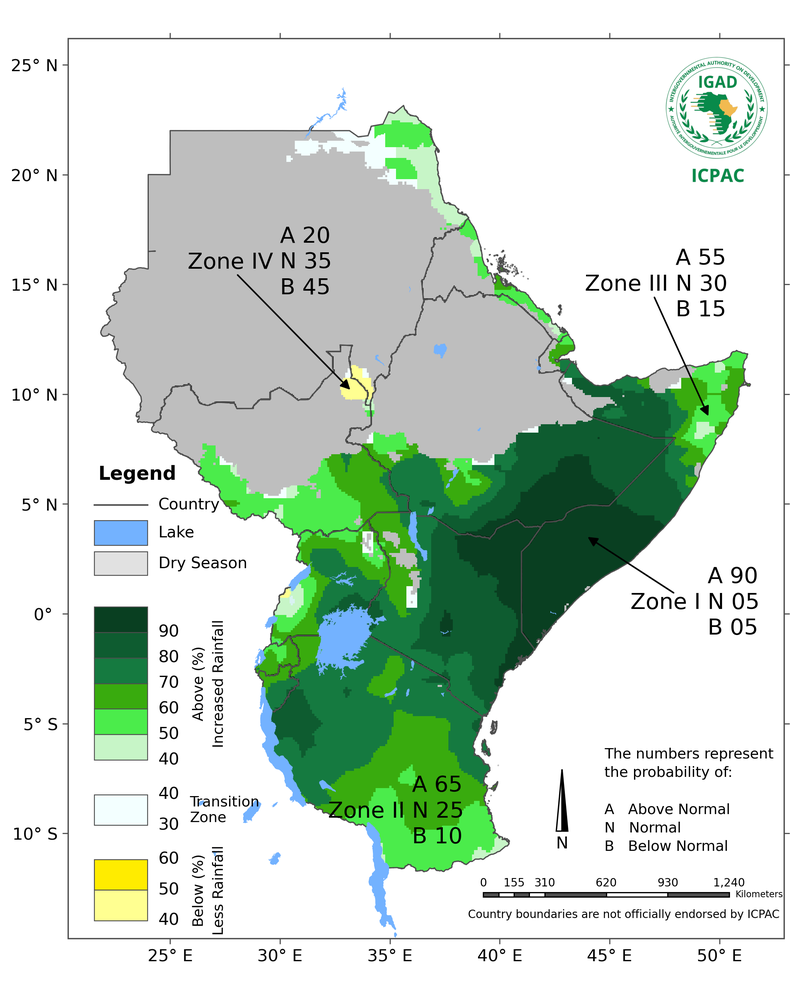
The regional downscaled rainfall forecast indicates an increased likelihood of wetter-than-normal conditions in the Greater Horn of Africa, with a 90% chance of enhanced rainfall over southern Ethiopia, central to southern Somalia, and north-eastern Kenya.
The forecast also indicates a high chance of seasonal rainfall exceeding 400 mm in parts of central to southern Somalia, central parts of Kenya, the Lake Victoria Basin region, Burundi, western Rwanda and western Tanzania.
The timing of the rains is expected to vary across the region. Early to normal onset is more likely across much of the eastern and southern parts of the region, including Somalia, central and eastern Kenya, southern Ethiopia, and most parts of Tanzania.
The temperature outlook indicates an increased likelihood of warmer-than-average temperatures across most parts of the region. The highest probabilities are indicated over the eastern parts of the region, particularly eastern Kenya, Ethiopia, Eritrea, Djibouti and much of Somalia.
Based on the current climate conditions and the expected evolution of El Niño and the Indian Ocean Dipole (IOD), 1997 and 2023 have been identified as relevant analogue years. During these years, wetter-than-normal conditions were observed across much of the region during OND. Analogue years provide useful context for preparedness and planning; however, this forecast remains the primary reference for decision-making for the OND 2026 season.
ICPAC will continue to provide regular regional updates, while NMHSs will issue detailed country-specific forecasts and advisories. ICPAC encourages stakeholders and users to follow the updated weekly, sub-seasonal and monthly forecasts.
FSNWG Special Report on El Niño
……. End …….
Note to Editors:
GHACOF 74 was convened as a hybrid event on the 17th and 18th of August 2026. The Forum was attended by representatives from the 10 countries of the Greater Horn of Africa region (Burundi, Djibouti, Ethiopia, Kenya, Rwanda, Somalia, South Sudan, Sudan, Tanzania, and Uganda), alongside national representatives from key sectors (agriculture and food security, livestock, water resources, health, disaster risk management, conflict, climate change, blue economy, energy and media), NGOs, humanitarian agencies, media, and development partners.
For media interviews and requests, please contact
Paula Machio: paula.machio@igad.int
Emebet Jigssa: emebet.jigssa@igad.int
Edwin Kiplagat: edwin.kiplagat@igad.int